
What Is HVAC? Basics of Heating and Cooling
Class 1 of 10

Class 1 of 10
What Is an HVAC System and How Does It Work?
Class 2 of 10

Class 2 of 10
How Does an Air Conditioner Work?
Class 3 of 10
Class 3 of 10
How Does a Heat Pump Work?
Class 4 of 10
Class 4 of 10
How Does a Furnace Work?
Class 5 of 10

Class 5 of 10
What's a Humidifier? And How Does It Help Indoor Air Quality?
Class 6 of 10

Class 6 of 10
Whole House Dehumidifiers: How They Work and How You Benefit
Class 7 of 10

Class 7 of 10
Ductless Mini-Splits 101: What They Do & How You Benefit
Class 8 of 10

Class 8 of 10
Indoor Air Quality: Air Filtration & Air Purifying HVAC Products
Class 9 of 10

Class 9 of 10
What Is a Dual Fuel HVAC System?
Class 10 of 10

Class 10 of 10
How Does a Furnace Work?
How does a furnace work? We walk through the heating cycle from start to finish to give you a comprehensive understanding of the underlying mechanics of heating your home.

Author:
Revised:
November 6th, 2020
Do you know how a furnace works? I’m willing to bet you know some parts of the process. But very few homeowners understand the entire heating cycle that takes place in their home thousands of times each year.
Why is it important to know the process? Knowing how a furnace works, and in a larger sense how your entire HVAC system works, can benefit you in a number of ways:
- When something breaks down, you’ll have a better understanding of why it happens
- Understanding the heating cycle can help you choose HVAC partners committed to best practices in installation and maintenance
- You can better understand the types of furnaces that are out there and what the benefits and drawbacks are for each of them
Ultimately, information is never a bad thing. And in an ideal scenario, that information can help you make better decisions for your home.
Ready to see how much you know? Good, because we’re ready to drop some knowledge.
The Home Heating Cycle
Every furnace has a sequence of operations. Over time, the “standard” sequence of operations has changed as technology has advanced. Some principles remain true, though.
A heating cycle will begin when the thermostat senses a difference between its settings and the temperature in your home. The thermostat will then initiate a call for heat to your furnace unit.
On many older systems, there is a pilot that is lit all the time, and this would provide the initial fuel for the furnace’s burners. There are also systems with a direct ignition spark, kind of like a spark plug in a car. In modern systems, most have a hot surface ignition, which is sort of like a cigarette lighter in a car. If it’s an electric furnace instead of gas, propane, or oil, heat coils in the main cabinet will begin to heat up.
Regardless, the ignition will occur at this point, which will begin to produce heat.
At this point, in older systems, heat would simply rise into the heat exchanger. This was inefficient. In modern systems, there is a venter motor that will push the heat from the burners through to the heat exchanger at a metered rate. This motor will generally run for a preset amount of time, depending on the need for heat in the home.
Meanwhile, in gas furnaces (the most common kind here in Central Ohio and much of the northern part of the country) the gas valve is opened to provide fuel for the burners. On the opposite end of the burners is a flame sensor, which is a device that is intended to monitor the proper functioning of the burners. A low-voltage signal will pass to the flame sensor that indicates proper operation.
There’s a brief delay between these stages and air being circulated throughout your home. During this time, the heat exchanger warms up. The circulating fan, or blower motor, will then turn on. This is what moves the air throughout your ductwork and vents and into your home.
A small amount of heat won’t be transferred directly to the ductwork, depending on the efficiency of your furnace unit. This excess heat will be vented, usually through a chimney flue or PVC pipe that runs to the central cabinet from outside your home.
At the end of the cycle, the thermostat will again send a signal to the circuit board on your furnace, which initiates a shutdown. The unit will then begin cooling, in preparation for the next call for heat from the thermostat.
Safety Precautions
Older furnaces have less built-in safety devices. In some extreme cases, none at all. Modern systems are built to correct this error.
For example, rollout switches will trigger if the heat exchanger is breached (heat exchanger cracks are an occasional reason furnaces need to be repaired or replaced). The sensors on them will click, triggering a shutdown of the system.
Similarly, the heat sensor we mentioned earlier is a good early-warning system that wasn’t built into a lot of older furnaces.
Things can still go wrong, to be clear. That’s why routine maintenance is so important. But these additional features of modern furnaces will increase peace of mind for a homeowner.
Furnace Parts & Systems
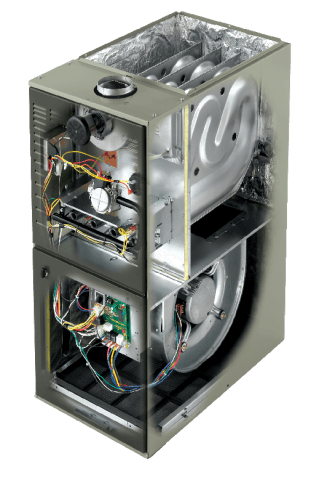
It’s not necessary to know every component of a furnace. That’s what our installers and service technicians are for. However, understanding the major components and how they operate together can aid an understanding of the system as a whole.
Blower Motor - The furnace’s blower distributes warm air throughout your house through the ductwork. Importantly, this blower fan circulates air on the cooling side as well. This is the primary reason why having compatible heating and cooling systems is so important.
Heat Exchanger - A series of metal tubes that hold heat from the furnace’s heat source. The air of your home is warmed when air is moved across the heat exchanger and into your ductwork.
Combustion Chamber - This is where the magic happens with the heat exchanger. It’s the open area where air will move across it. This area needs to be kept clean and undisturbed and is one of the many areas that’s cleaned during routine maintenance.
Filter - How have we not mentioned the filter yet? Your filter isn’t just for the furnace, but air conditioning as well, but remains an important part of both. It filters the air that is returning to the furnace, after having been circulated throughout your home. For the long-term safety and efficiency of your system, keeping dirt and dust particles out of your furnace parts is extremely important. An inefficient or dirty filter can muck up your entire HVAC system!
We covered a number of other parts above when discussing the heat cycle, and there are even a few we haven’t mentioned yet. Hopefully, though, you know how each of these parts relates to the whole.
RELATED: An Interactive Model of a Furnace

Differences Between Furnace Models
A lot of people like to focus on differences between furnace brands. While, yes, there are variations in parts and construction between brands, the basics of the heating cycle are going to remain true for any brand of furnace.
The bigger difference is going to be in the technology in the furnace itself. Primarily, this will change when a furnace is single-stage, two-stage, or variable-speed.
In brief, a one-stage furnace only has an “on” and “off” setting. It’s at 100% or 0%.
A two-stage furnace will have one additional stage, usually 60-70%. This gives it some flexibility in heating options, which can reduce energy usage, increase your comfort, and reduce wear and tear on your system.
A variable-speed furnace can have numerous stages, from 5-6 stages all the way up to 100s! It gives homeowners a lot more control over their energy usage and comfort.
RELATED: Single-stage, Two-Stage and Variable-Speed Furnaces: Benefits & Comparisons
The big differences in function between these types will be with the blower motor and thermostat. To be able to control the system properly, the thermostat needs to be more sophisticated than it would for single-stage or two-stage systems.
Similarly, the blower motor needs to be able to operate at 60-70%, not just 100%, with a two-stage unit. And with variable-speed furnaces, the blower motor needs to be able to modulate between a ton of stages, to match the heating output.
Differences In Energy Source
The other major difference will relate to energy sources. Much of what we’ve talked about in regard to gas valves and burners will not be applicable for an electric furnace. And because many of the safety measures in gas furnaces are related to the gas itself, these precautions are different. For example, electric furnaces will have fusible links that will burn out if the system overheats, which will trigger a precautionary shutdown.
Other small exceptions will exist as well, like the fuel delivery method for oil furnaces, which disperses and atomizes the fuel before it’s consumed. Again, though, the basic steps of the heating cycle will remain the same regardless of your energy source and specific configuration.
How Furnace Efficiency Is Measured
Furnace efficiency is measured in AFUE, which stands for Annual Fuel Utilization Efficiency. It’s measured in percentages and is a calculation of how much heat generated by a furnace goes directly toward heating your home.
Think of it this way: if you spend a dollar to heat your home, and you have an 80% efficiency furnace, 20 cents of that dollar will be vented from your home rather than going toward heating it.
Standard modern furnaces are generally 80% efficient. Anything that is considered a “high efficiency” furnace unit will be 90% or higher. The most efficient furnaces can get up to about 98%.
Occasionally (particularly if you have an electric system) a home will have a heat pump instead of an air conditioner, and heat pumps will provide heat in the colder months as well. These are measured in HSPF, or Heating Seasonal Performance Factor. Similar to AFUE, it’s just a calculation that gauges efficiency.
Older equipment can have HSPF ratings as low as 5 or 6, while the top modern systems can be 12+.
RELATED: SEER, AFUE and HSPF Ratings in HVAC: Why They Matter
Furnace Maintenance, Repair and Lifespan
How long should your furnace last? What if I told you that I’ve seen working furnaces that are over 30 years old, but that the average lifespan for a system is closer to 8-10 years?
We can’t guarantee 30 years for a couple of important reasons, but 8-10 years is unacceptably low to expect out of a modern furnace. Why is that? Simply put, with proper, proactive maintenance, there’s no reason you can’t expect 15+ years out of your furnace.
The reasons you see such low averages are predictable, but preventable:
- Maintenance. Have your furnace maintained once a year following installation. You’re adding years of life to it simply by doing this.
- Filter Changes. Sure, if you miss your recommended filter change by a month once, it won’t kill your furnace. But if that becomes a habit, yes, it will take years off of the system’s life. Filters don’t just affect the air quality that you breathe; a clogged filter will put strains on your entire heating system that can cause eventual breakdowns.
- Installation Best Practices. Think all installations are the same? Think again. The Department of Energy has verified that improper installation can amount to up to a 30% reduction in efficiency. Frankly, based on our professional experience, that number may be generous. We’ve seen bad installations that have resulted in large repairs or even replacements after only a handful of years. While it’s rare for an installation to be that bad, it’s much more common for corners to be cut that can cost you over time.
RELATED: Furnace Installation From Start to Finish
Enjoy the Comfort of a New Furnace
Now that you know the basics of furnaces, both in terms of their construction and operation, you’re ready to take some next steps.
Below I’ve listed a few resources that you might find useful. I’d encourage you to continue to educate yourself as you approach your next big HVAC project. Knowing the reasons behind a decision can help you avoid common pitfalls in furnace or A/C installation and maintenance. It can also help you to pick the best HVAC partner for your next job.
Additional Resources:
