


Author:
Revised:
January 3rd, 2024
The humidity in your home’s air is as important as temperature when it comes to the comfort of your home.
Does that seem like a bold statement? I’m happy to elaborate.
When we think about heating and cooling our homes, we tend to focus on the temperature. Relative humidity plays an important factor in how this temperature feels, though.
Further, humidity affects other aspects of our home as well, such as how easily certain insects can live in our walls, whether or not mold can grow in our HVAC system, or how rough allergy season will be.
The good news is that HVAC equipment is designed to manage these issues, as well as many others. But sometimes, it requires proactive management on the part of homeowners.
This article is intended to do a few things:
- Help you understand how HVAC products control your humidity
- Help you determine which ones are the most necessary for your comfort needs
- Help you determine which ones aren’t the most necessary for you
All three are important, and it’s not always about adding more pieces of equipment. What it is, though, is about identifying areas of need based on your personal circumstances, and figuring out how to solve those issues.
Proactive Humidity Control
The relative humidity in your home, even here in central Ohio, can reach as low as 15% in the winter.
For reference, the average relative humidity of the Sahara Desert is 25%!
Low humidity can irritate your respiratory system. It can dry out your skin. It can increase your risk of illness. It can even cause structural issues within your home. Some wooden floor manufacturers will only provide warranties for their work if the home has a whole-home humidifying system.
I start with low humidity issues, because they’re often less known than high humidity issues. However, the other side of the humidity coin does indeed exist.
Problems associated with humidity (high or low) can include:
- Allergies, either seasonal or due to a specific environmental trigger
- An overly-warm upstairs or finished attic
- Musty smell
- Black mold or other mold growth in damp areas
- Asthma issues
- A general decrease in comfort
- Permanent window fog
- Irritated throat in the winter
- Wild discrepancy between temperatures on different floors of the home
- Spiders, bug infestations, and cobwebs
- Creaky floorboards in a dry environment or moisture damage in humid environments
- Cupped wood floors
- Water stains
- Peeling or blistering wallpaper and paint
You may not experience each of these (and if you experience none of them, congratulations!), but even one or two can be comfort-killing if they aren’t kept in check.
So let’s unpack each, and see what can be done to mitigate them.
How often is your basement damp in the summer? For many here in Ohio, the answer is “Often.” The relative humidity is regularly 80-90% in Central Ohio and many similar climates.
Anything past about 60% relative humidity, and you’ll be at risk to develop black mold. While an ideal level can vary, 30-60% is generally a safe range to stay within.
Many insects also absorb moisture through their skin, which is how they stay hydrated. Higher levels of humidity will allow more to thrive in your home. While the best range for minimizing bugs can again vary, at or below 50% humidity is a good rough guideline for managing potential bug problems.
Knowing that, how can you proactively manage your humidity levels? Let’s look at some options:
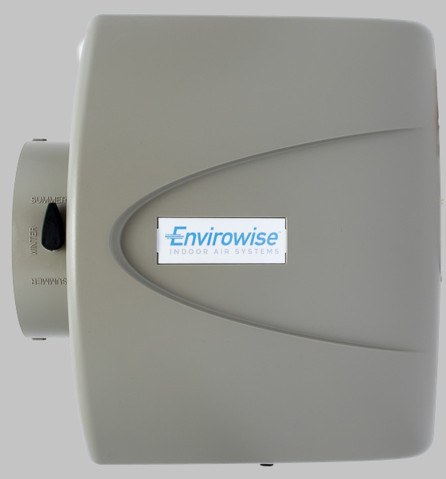
Whole-Home Humidifiers
A ducted, whole-home humidifier is a great solution to this. Some homes do fine in the winter, but if you experience any of the issues listed above, you’ll benefit greatly from a whole-home humidifier.
Costs can vary, but a couple of rules tend to hold true:
- The larger your home, the more powerful your humidifier will need to be, thus affecting cost.
- It’s generally cheaper to have this installed at the time of a full HVAC system replacement. You’ll save on labor costs, and may also be able to take advantage of company incentives for pairing equipment and services.
Mobile humidifiers will cost less, and can be useful for specific situations. But they will never be able to service an entire home, or even a meaningful portion of it.
Whole-Home Dehumidifiers
On the flip side, a dehumidifier is going to be a boon in the summer months. Fewer allergies, fewer bugs, less mold, less window fog, fewer smells, etc.
And more comfort. Many forget that humidity is equal to heat for humans. You’ve undoubtedly seen the “heat index” or “true feel” temperature when checking the weather. This accounts for how humidity levels affect how we experience heat. Thus, dehumidifying isn’t just about mold or allergies. It’s about how easily you can cool your home, and how comfortable you are.
Whole-home dehumidifiers. They can be standalone or ducted fully into your ductwork. Additionally, many can be connected to your central HVAC controls, making them programmable from the thermostat. These options are what will increase the cost within that rough range.
That price can produce some sticker shock, but it’s important to remember that your air conditioner will be working far less, potentially saving you hundreds of dollars per year, with a whole-home dehumidifier installed. These can absolutely pay for themselves over time, in addition to providing you with years of comfort.
RELATED: Is a Whole-Home Dehumidifier Right For Me?
Variable-Speed HVAC Equipment
Have you ever walked into a large retail store in the heat of summer, and it’s very hot and humid outside? You enter the store and it’s much cooler, but it’s a “wet cold” that is still humid. You might even feel the moisture on your skin more acutely.
There’s a reason for this, and it’s related to the functioning of the store’s HVAC equipment. The same phenomenon can have implications for your home.
Your air conditioner controls humidity as well as temperature, since the two are closely tied to one another. A traditional one-stage air conditioner only has two settings: on and off. It’s either functioning at 100% or 0%. Two-stage equipment has one more, usually at about 70% capacity.
Variable-speed HVAC equipment has hundreds of stages. This can be very meaningful for controlling humidity (and thus, your comfort).
So, for an example: You set your thermostat to 72 degrees. The single-stage air conditioner kicks on and cools the home to 71 degrees, then shuts off. The house warms up to 73-74 degrees, and the unit kicks on again. And so on over and over.
That downtime adds up when it comes to humidity control, though. Let’s say your unit is on 50% of the time past the point where it first reaches 72 degrees. A variable-speed system will get to 72 degrees at 100% capacity, just like the single-stage unit, but then it will decrease its output to as low as 40%. Your total uptime for a variable-speed unit might be as high as 90% during the day. This does a few great things:
- It keeps the temperature in your home constant.
- The higher uptime means it is dehumidifying constantly.
- The lower capacity means that, despite the additional uptime, you’re using less overall energy.
The result is a home with both the temperature AND humidity better controlled.
Let’s head back to our large retail store. Their units aren’t prepared to handle the opening and shutting of the main doors thousands of times per day on the hottest and most humid days of the year. So it’s cooling the air, but is unable to manage the humidity properly.
This has implications for your whole home. Better humidity control means that the humidity won’t be able to rise to your upstairs as easily. Do you have an upstairs that can be 20 degrees warmer than the downstairs (and even more compared to the basement)? More often than not, that’s improper humidity control.
Some homes are damp in the winter too. It’s rarer, but in these cases, a mixture of an efficient air conditioning unit and dehumidifier can be the best option, since it wouldn’t make sense to run the air conditioner in winter.
Considerations for Humidity-Controlling Products
Budget is a consideration, of course, and we haven’t talked much about it so far.
It’s true that some of these products can and will pay for themselves over time, but there’s still the initial investment to consider.
There are also low-budget options for many products, but in HVAC, you get what you pay for.
So could you buy a standalone dehumidifier for your home? Sure. But it’s likely going to cost more to run annually, and most won’t be a fraction as efficient at removing moisture from the air.
Could you buy a single-room humidifier for, say, your bedroom? Yes, and it will help when you’re in that room, but it won’t do anything about the systemic, house-wide problems caused by low relative humidity.
The other important thing to remember is that these can save you hundreds on heating and cooling costs per year. The cost of a ducted dehumidifier is a substantial initial investment, for example, but if they stay in the home for even 5-10 years, they’re making that money back in utility costs.
Putting It All Together: Control Your Humidity, Control Your Comfort
Individually, each of these products can help, but as I mentioned at the start, the important question is which ones are going to be right for you.
When you have an HVAC representative in your home to discuss options, asking about humidity-controlling products is recommended. It may be that you need nothing outside of your base system, but if you have any areas of concern (and if you made it this far, I’m guessing you do), it’s always worth consideration.
Ready to talk to a professional about your specific options? Check to see if you’re in our service area below, or give us a call. We’d love to speak with you!
I’d also encourage you to check out the other side of “indoor air quality.” Namely, filtration and air purification products. Combined with this article, it will give you the full picture when considering indoor air quality products.
ARTICLE: Control Your Comfort: Air Filtration & Air Purifying HVAC Products
