


Author:
Revised:
April 20th, 2023
The Inflation Reduction Act of 2022 has been a topic of conversation with many of our customers; while the information can be challenging to comprehend (whether you work in the HVAC industry or not), who wouldn't want to take advantage of tax credits, especially if they qualify?
What Is The Inflation Reduction Act (IRA)?
First things first, it’s crucial to know what the Inflation Reduction Act is and why it's important. In August of 2022, the U.S. Government passed the Inflation Reduction Act. The Inflation Reduction Act incentives cover a broad spectrum of American life, like healthcare costs, energy efficiency upgrades, clean/renewable energy for electric vehicles, and even HVAC systems.
These incentives empower Americans to make their homes (buildings or offices) more energy efficient. In fact, one of the bill's main goals is to address climate change, help businesses and residential homes adopt more eco-friendly HVAC measures, and jump-start clean energy production.
What Are The IRA Incentives?
Two rebate programs and four tax credits are available for eligible homeowners who take advantage of the bill. Before getting into each incentive, let’s review the difference between a rebate program and a tax credit.
● Rebate Program- is a rebate that is administered at the state level and advocates for lower-income households. Federally qualified rebates CANNOT be combined with other rebates and are intended to be used at the point of sale.
● Tax Credit- is a part of the federal income tax credit and is available to U.S. citizens with a taxable income. Federal tax credits CAN be combined with other tax credits and filed the next tax season.
What Are the Two Rebates Included in the IRA?
With this new bill, eligible homeowners can submit two types of federal rebates: the High-Efficiency Electric Home Rebate Act (HEEHRA) or the HOMES rebate. Let’s dive deeper into each type of rebate plan.
High-Efficiency Electric Home Rebate Act (HEEHRA)
This rebate program is especially relevant for homeowners considering high efficiency HVAC equipment. Depending on your household income, you may qualify for rebates on eligible home energy improvements, including heat pumps, electrical panel upgrades, and wiring needed to support new equipment.
Eligibility is based on household income and other program requirements established by your state. Qualifying homeowners may receive rebates that cover a significant portion of eligible project costs.*
*Program details, eligibility requirements, and available incentives are subject to change and vary by state. Consult a licensed tax professional or your state's energy office for the most current information.
What Qualifies as Energy-Efficient Home Improvements?
● An electric heat pump, A/C, or natural/ gas furnaces
● Mitsubishi Electric Ducted/Ductless heat pumps
● Water heaters
● Insulation
● Windows
● Doors
● Upgrading your electrical panel/ breaker box
● Home energy audits
On top of that, eligible homeowners can also take advantage of the extended Residential Clean Energy Credit, which gives qualifying homeowners a 30% tax income credit for clean energy equipment installed between 2022 and 2333. Below lists a few of the qualifying residential equipment.
● Rooftop/Solar/ Wind Energy
● Geothermal Heat Pumps
● Battery Storage
Nevertheless, we feel it's important to mention that this refund is nonrefundable and cannot exceed your total tax amount.
HOMES Rebate Program
The HOMES rebate is a performance-based whole-home program that offers homeowners rebates for improving and retrofitting energy-efficient home upgrades. This incentive can be used to improve the energy performance of single-family or Multi-Family homes/buildings.
The rebate program has no income limits; however, depending on your HVAC contractor, a specific household income must be met. On top of that, third-party verification may be required to ensure the system meets the promised energy bill savings.
Federal Tax Credits
Eligible homeowners may also qualify for federal tax credits when installing qualifying high efficiency HVAC equipment and other energy efficient home improvements. Available incentives vary based on the type of equipment installed and current federal requirements.
Because tax laws and program requirements can change, homeowners should verify eligibility with a qualified tax professional before making a purchasing decision.
How To Qualify for IRA Rebates and Tax Credits
Now that we got the logistics out of the way, and if you’re anything like me, you’re probably wondering, “How do I qualify for these tax incentives?” Well, the best way to find out if your home upgrade qualifies for a rebate or tax credit is by visiting the Consortium for Energy Efficiency (CEE) website and using their Directory of Efficient Equipment database.
The CEE is the US and Canada consortium of gas and electric efficiency program administrators. They work together to advance the development of energy-efficient products and services that will have a lasting public benefit.
For your new investment to qualify for any of the rebates or tax credits in the Inflation Reduction Act, it must meet the minimum CEE requirement for that tier.
Below is an infographic explaining the three tiers (CEE Tier 1, CEE Tier 2, 3, 4, and CEE Advanced Tier) and their energy star efficiency. Keep in mind that under this new legislation that 70% of the current products (or base tier) will not meet the 2023 minimum efficiency standards.
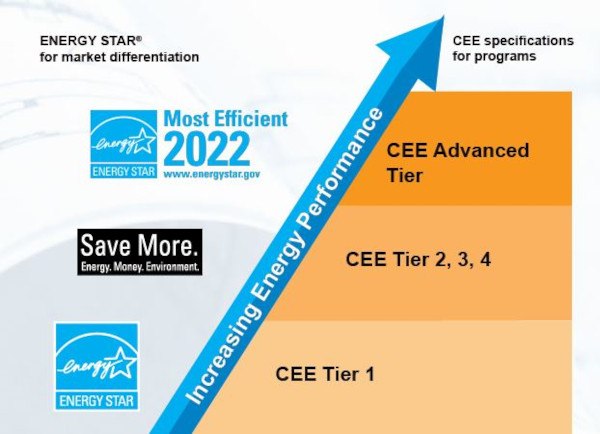 Photo Source: ENERGY STAR
What Do These Energy Programs Mean for Homeowners?
This tax incentive is a state-by-state case, meaning each state will be responsible for creating its state's rules regarding the Inflation Reduction Act. Then, after the Department of Energy (DOE) sets its guidelines, which should be released this summer.
Once the guidelines are laid out state by state, each state will have until August 16, 2024, to submit its DOE plans to be approved. Once approved, funds will be released to the state to be implemented into the rebate program.
However, it's worth mentioning that this money is NOT a given; your state will have to opt-in to receive funding from the DOE, each state is responsible for creating its rebate rules, and homeowners will not have access to their rebates until late 2023 or early 2024.
Remember, your appliances must meet or exceed the highest efficiency tier set by the Consortium for Energy Efficiency (CEE) to get the tax credit.
Nevertheless, if a new HVAC system isn't in your household budget this year, as mentioned above. In that case, there are also incentives to make energy-efficient improvements, including insulation, installing solar panels, or electric car chargers.
Thus, going green while saving some green on your monthly energy bill.
How To Claim Your IRA Rebates & Tax Credits
In order to claim your IRA tax rebates and credits, taxpayers need to complete (or have your tax expert) the IRS Residential Energy Credits Form 5695.
However, before you get to that step, there are a few documents you may need to have in your possession before filling out your tax form.
It’s important to note here that you may not need all of the documents to file your tax rebate/credit; nevertheless, homeowners should keep all of this information in a safe place, and when it comes to money, it’s better to be safe than sorry.
● ARHI Certificate- this certificate is given by the Air Conditioning, Heating, & Refrigeration Institute.
The ARHI certificate gives a third-party, unbiased SEER rating, which is used nationally to determine the SEER rating on HVAC systems and equipment. Since they are not a manufacturer or an HVAC contractor, this certificate is the least biased and most accurate SEER rating when all components of the system are entered. It can be obtainable by homeowners by visiting the CEE Directory of Efficient Equipment.
● Manufacturer’s Certification Statement- this is a signed statement from the manufacturer verifying that the product and/or component qualifies for the given tax credit.
If you cannot find your original Manufacturer’s Certification Statement, you can look on their website or call the manufacturer directly.
● An invoice with the serial and model numbers of your equipment- at Fire & Ice, we print your product serial and model number on your original invoice.
If you cannot find your original invoice, please call us, and we can provide the correct installment details.
Then fill out the form and see if your tax rebate or tax credit is approved.
What Are the Next Steps?
Given the various requirements of The IRA, each homeowner will need to review their individual tax situation in order to determine which rebates/credits they are eligible to take.
Remember that it is still early in the process, and additional clarifications and guidelines are more than likely to come. We will continue to add to this article as more information becomes available.
Nevertheless, that shouldn't stop you from upgrading your HVAC system to a higher efficiency system because, in the end, investing in a new home comfort system will save on energy, which is great for your wallet and the environment.
If you have any questions regarding the IRA tax credit/rebate, please contact your tax professional to ensure you take advantage of all tax breaks available on your new HVAC equipment.
We are happy to assist homeowners in the purchase of a new energy-efficient system, but we can only provide you with information and resources necessary to make your decision.
Any recommendation or suggestion given to you by ANY HVAC contractor should be vetted by a trusted tax professional before taking action.
If you're considering purchasing a new home comfort system and want to start your HVAC journey with Fire and Ice, click below to schedule a service or estimate.
